Home Blog Page 16

Africa’s first LGBTQ+ shelter needs help to gear up for winter

0

The Pride Shelter in Cape Town houses 20 people, who can stay for up to three months

By Ashraf Hendricks

The Pride Shelter is Africa’s first LGBTQI+ shelter and has been running since 2011. Based in Cape Town, the shelter accommodates 20 people, who can stay there for up to three months.

As winter approaches, the Pride Shelter’s building is in need of repairs to keep out the cold and the rain. Nicole Joy Alexander, Director of the Pride Shelter Trust, says that they need help with painting, electrical maintenance, plumbing and other repairs to keep the shelter in good condition.

The shelter is trying to raise R80,000 to cover these repairs through a BackaBuddy campaign, and has asked for volunteers to help.

This article was republished from https://www.groundup.org.za/article/africas-first-lgbtq-shelter-needs-help-to-gear-up-for-winter/

Find out more at: https://bit.ly/3xJlZ49

Follow South Africans UK on Facebook and Instagram.

Join the South African UK map and subscribe to our newsletter.

Saffa and Friends Braai

0

We are having our Saffa braai on 18 June. We found a very pleasant well-stocked club house with lots of seating indoors and outside. There is also ample parking and we love the outdoor area where we are allowed to braai. There are also play facilities for children to keep them entertained while the adults do their thing. I can’t see a local train station nearby but as it’s not far from central Wakefield I have been told that a taxi is no more than a fiver to central Wakefield and around £10 if you are on the outskirts. Steve will be bringing his mobile shop so we will have plenty of Saffa favourites, biltong, boerie on sale as well as all your favourite brandy and beers behind the bar. We hope to see you at Slazengers on Saturday 18th June.


https://www.facebook.com/events/

Family Braai Day

0

Come celebrate family braai day and all things South African with us at Mannings Heath in West Sussex – with our warm hospitality, fine wines and fabulous views over the golf course. We invite you to relax on our terraces, enjoy a delicious braai (BBQ) – and soak up the summer sun with your friends and family.

  • Live entertainment and great South African music
  • The kids can play Kubbs, tennis, football, and many other fun-filled activities.
  • Stalls filled to the brim with the best of South African gifts, treats and services.
  • South African braai (BBQ) at its best

Limited tickets are available. Reserve your Braai Day experience today.

Tickets: Adults: £18 | Kids under 12 years: £10  | Date: 3 July 2022 | Time: 12:00pm  


Sokkie Jol

0
EARLY BIRD TICKETS ARE ON SALE NOW!
SAVE THE DATE
When: Saturday 11th June 2022
Where: The Hub, Cambourne, Cambridgeshire
Ticket sales will open soon!

City of Cape Town stops Brass Bell restaurant from building on beach

0

By Liezl Human

Owner wanted a wooden deck to provide people with “an area to sunbathe without getting covered in sea sand”

The Brass Bell in Kalk Bay started construction on the baby beach this week without the necessary approvals, prompting the City of Cape Town to intervene.

After photos circulated that construction was taking place at the Kalk Bay Tidal Pools that surround the landmark Brass Bell restaurant, the City of Cape Town and the National Department of Forestry, Fisheries and the Environment (DFFE) made a site visit on Wednesday.

Mayco Member for Spatial Planning and Environment Eddie Andrews said they had requested that the Brass Bell cease all construction for now.

A meeting between the City, the DFFE Oceans and Coasts Environmental Compliance, and the Passenger Rail Agency of South Africa (PRASA) has been scheduled for next week.

PRASA owns the land which is leased to the Brass Bell. The construction took place within 100 metres of the high water mark, which requires environmental authorisation in terms of the National Environmental Management Act (NEMA).

The City said that “although the work is within 100m of the high water mark, a determination also has to be made as to whether it is a pre-disturbed footprint or not”.

Tony White, owner of the Brass Bell, said the plan was to build a wooden deck to provide people with “an area to sunbathe without getting covered in sea sand”.

He said he had no idea that approval by PRASA was required. “I now know this to be the case and will not proceed with the deck unless I have formal approval,” said White.

According to Andrews, a coastal by-law adopted in 2020 ensures the right of public access to the entire coastline and coastal amenities.

“The Brass Bell has been formally informed that should they prevent public access they will be served with a legal notice in terms of the Coastal By-law,” said Andrews.

The Brass Bell expanding has been an issue for years according to Faez Poggenpoel, a fifth-generation fisherman in Kalk Bay and representative of the small-scale fishing community. He said the “unrestricted” access is actually the “thin slippery wall of the tidal pools in order to get to the other side”.

“That’s by no means safe access for our people,” he said.

Steve Herbert, a resident, said the community has over the years tried to stop or restrict expansion of the Brass Bell. “And so it’s gone on until there’s virtually nothing left of what was common ground,” said Herbert.

White said that when he first moved to Kalk Bay 55 years ago “the kiddies pool area was in a sorry state of neglect and remained so until I took over the lease”.

Herbert raised concerns about the lease agreements between PRASA and the Brass Bell. The City confirmed that it did not have a copy of the lease.

PRASA spokesperson Andiswa Makanda said when the construction was brought to their attention, a letter was issued to the Brass Bell requesting approval documents. PRASA asked the owner to cease all construction pending the necessary approvals.

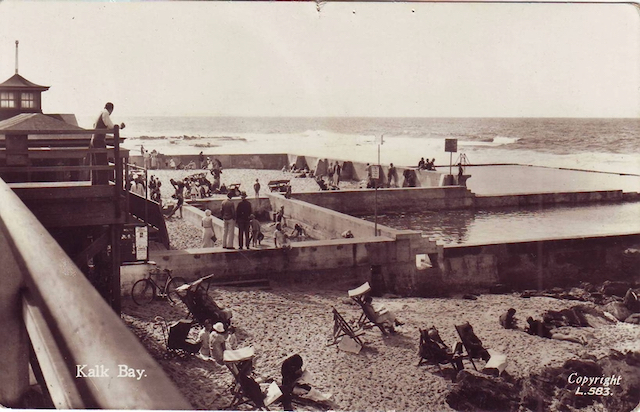
A postcard from 1914 shows the Kalk Bay tidal pools and beach before construction in the area. These areas are now almost completely built over. (Since the photo is so old, we understand that it is no longer under copyright.) Update on 2022-04-05 13:00

This article was updated to include a brief response from PRASA.

Main Photo: Liezl Human

Find out more at: https://bit.ly/3xJlZ49

Follow South Africans UK on Facebook and Instagram.

Join the South African UK map and subscribe to our newsletter.

Elon Musk Buys Shares in Twitter

0

South African billionaire Elon Musk has bought a 9.2 per cent stake in Twitter, making him its largest shareholder. Musk recently criticized Twitter in a series of tweets, questioning the company’s commitment to free speech and whether a new social media platform was needed.

Twitter is now appointing Elon Musk to its board of directors until 2024.

“The Company will appoint Mr. Musk to the Company’s Board of Directors (the “Board”) to serve as a Class II director with a term expiring at the Company’s 2024 Annual Meeting of Stockholders,” the filing says. “For so long as Mr. Musk is serving on the Board and for 90 days thereafter, Mr. Musk will not, either alone or as a member of a group, become the beneficial owner of more than 14.9% of the Company’s common stock outstanding at such time, including for these purposes economic exposure through derivative securities, swaps, or hedging transactions.”

Watch: Black Coffee Wins first ever Grammy Award

0

It’s a first Grammy Award for South African artist Black Coffee who won the Best Dance/Electronic Album at the 2022 Grammys for his Subconsciously album.

This is the first time a South African producer has won or been nominated in this category.

Black Coffee said he is so proud to represent South Africa, sending out the message “It’s possible” to all the kids in South Africa.

Follow Black Coffee:
http://facebook.com/realblackcoffee
http://twitter.com/realblackcoffee
http://instagram.com/realblackcoffee
http://soundcloud.com/djblackcoffee

Smart devices spy on you – 2 computer scientists explain how the Internet of Things can violate your privacy

0

Roberto Yus, University of Maryland, Baltimore County and Primal Pappachan, Penn State

Have you ever felt a creeping sensation that someone’s watching you? Then you turn around and you don’t see anything out of the ordinary. Depending on where you were, though, you might not have been completely imagining it. There are billions of things sensing you every day. They are everywhere, hidden in plain sight – inside your TV, fridge, car and office. These things know more about you than you might imagine, and many of them communicate that information over the internet.

Back in 2007, it would have been hard to imagine the revolution of useful apps and services that smartphones ushered in. But they came with a cost in terms of intrusiveness and loss of privacy. As computer scientists who study data management and privacy, we find that with internet connectivity extended to devices in homes, offices and cities, privacy is in more danger than ever.

Internet of Things

Your appliances, car and home are designed to make your life easier and automate tasks you perform daily: switch lights on and off when you enter and exit a room, remind you that your tomatoes are about to go bad, personalize the temperature of the house depending on the weather and preferences of each person in the household.

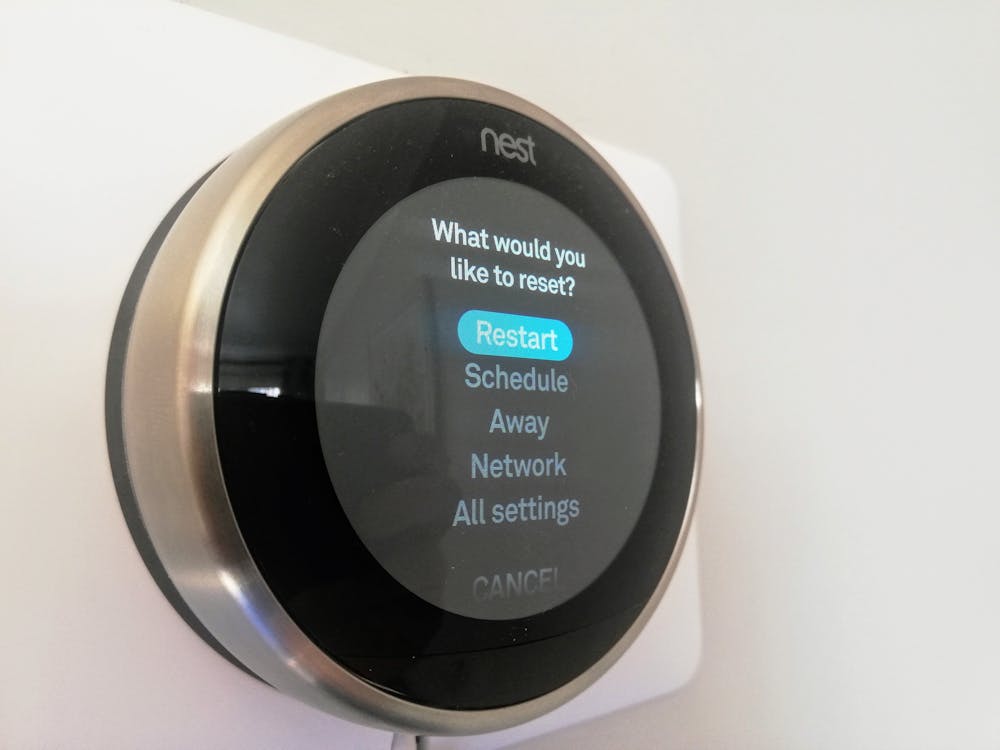
To do their magic, they need the internet to reach out for help and correlate data. Without internet access, your smart thermostat can collect data about you, but it doesn’t know what the weather forecast is, and it isn’t powerful enough to process all of the information to decide what to do.

A disk with a display screen mounted on a wall
The Nest smart thermostat tracks your presence and is connected to the internet. Smart Home Perfected/Flickr, CC BY

But it’s not just the things in your home that are communicating over the internet. Workplaces, malls and cities are also becoming smarter, and the smart devices in those places have similar requirements. In fact, the Internet of Things (IoT) is already widely used in transport and logistics, agriculture and farming, and industry automation. There were around 22 billion internet-connected devices in use around the world in 2018, and the number is projected to grow to over 50 billion by 2030.

What these things know about you

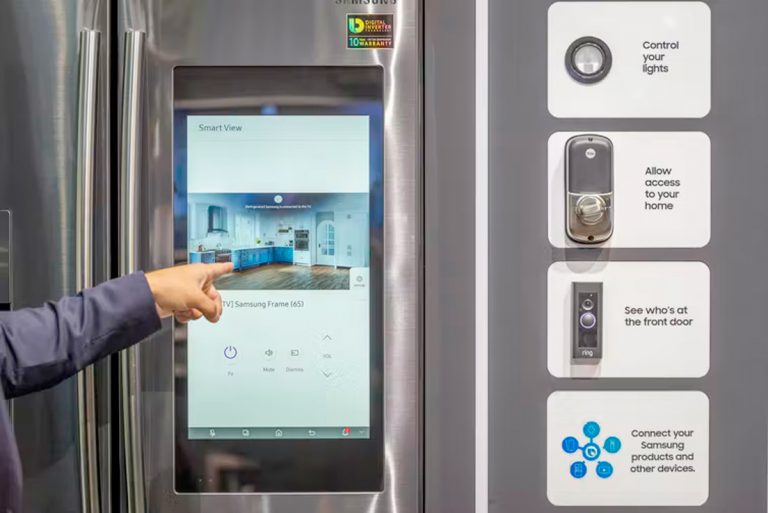
Smart devices collect a wide range of data about their users. Smart security cameras and smart assistants are, in the end, cameras and microphones in your home that collect video and audio information about your presence and activities. On the less obvious end of the spectrum, things like smart TVs use cameras and microphones to spy on users, smart lightbulbs track your sleep and heart rate, and smart vacuum cleaners recognize objects in your home and map every inch of it.

Sometimes, this surveillance is marketed as a feature. For example, some Wi-Fi routers can collect information about users’ whereabouts in the home and even coordinate with other smart devices to sense motion.

Manufacturers typically promise that only automated decision-making systems and not humans see your data. But this isn’t always the case. For example, Amazon workers listen to some conversations with Alexa, transcribe them and annotate them, before feeding them into automated decision-making systems.

But even limiting access to personal data to automated decision making systems can have unwanted consequences. Any private data that is shared over the internet could be vulnerable to hackers anywhere in the world, and few consumer internet-connected devices are very secure.

Understand your vulnerabilities

With some devices, like smart speakers or cameras, users can occasionally turn them off for privacy. However, even when this is an option, disconnecting the devices from the internet can severely limit their usefulness. You also don’t have that option when you’re in workspaces, malls or smart cities, so you could be vulnerable even if you don’t own smart devices.

Therefore, as a user, it is important to make an informed decision by understanding the trade-offs between privacy and comfort when buying, installing and using an internet-connected device. This is not always easy. Studies have shown that, for example, owners of smart home personal assistants have an incomplete understanding of what data the devices collect, where the data is stored and who can access it.

a toddler touches the top of a black cylinder on a dining table as a family eats in the background
Smart speakers continuously listen for your commands. Oscar Wong/Moment via Getty Images

Governments all over the world have introduced laws to protect privacy and give people more control over their data. Some examples are the European General Data Protection Regulation (GDPR) and California Consumer Privacy Act (CCPA). Thanks to this, for instance, you can submit a Data Subject Access Request (DSAR) to the organization that collects your data from an internet-connected device. The organizations are required to respond to requests within those jurisdictions within a month explaining what data is collected, how it is used within the organization and whether it is shared with any third parties.

Limit the privacy damage

Regulations are an important step; however, their enforcement is likely to take a while to catch up with the ever-increasing population of internet-connected devices. In the meantime, there are things you can do to take advantage of some of the benefits of internet-connected without giving away an inordinate amount of personal data.

If you own a smart device, you can take steps to secure it and minimize risks to your privacy. The Federal Trade Commission offers suggestions on how to secure your internet-connected devices. Two key steps are updating the device’s firmware regularly and going through its settings and disabling any data collection that is not related to what you want the device to do. The Online Trust Alliance provides additional tips and a checklist for consumers to ensure safe and private use of consumer internet-connected devices.

If you are on the fence about purchasing an internet-connected device, find out what data it captures and what the manufacturer’s data management policies are from independent sources such as Mozilla’s Privacy Not Included. By using this information, you can opt for a version of the smart device you want from a manufacturer that takes the privacy of its users seriously.

[Over 150,000 readers rely on The Conversation’s newsletters to understand the world. Sign up today.]

Last but not least, you can pause and reflect on whether you really need all your devices to be smart. For example, are you willing to give away information about yourself to be able to verbally command your coffee machine to make you a coffee?

Roberto Yus, Assistant Professor of Computer Science, University of Maryland, Baltimore County and Primal Pappachan, Postdoctoral Scholar in Computer Science, Penn State

This article is republished from The Conversation under a Creative Commons license. Read the original article.

Find out more at: https://bit.ly/3xJlZ49

Follow South Africans UK on Facebook and Instagram.

Join the South African UK map and subscribe to our newsletter.

Rhino Bonds – First of its kind to help save Black Rhino in SA

0

The World Bank recently issued the world’s first wildlife conservation bond, raising $150 million, some of which will be partly used for the conservation of the endangered black rhino population in South Africa.

The five-year ‘rhino bond’ will pay investors returns based on the rate of growth of the black rhino population at the Addo Elephant National Park as well as the Great Fish River Nature Reserve in the Eastern Cape. If successful, it may be replicated to protect rhino populations at three Kenyan reserves as well as other wildlife species such as lions, tigers and gorillas.

According to the World Wildlife Fund (WWF), South Africa accounts for about half of the black rhino population on the continent. Numbers had dropped to approximately 2500 in the 1990s but large scale conservation projects over the past few years have helped the Rhino numbers increase to approximately 5500.

“The pay-for-success financial structure protects an endangered species and strengthens South Africa’s conservation efforts by leveraging the World Bank’s infrastructure and track record in capital markets,” World Bank Group President David Malpass.

Pic source: www.worldwildlife.org/species/black-rhino

Find out more at: https://bit.ly/3xJlZ49

Follow South Africans UK on Facebook and Instagram.

Join the South African UK map and subscribe to our newsletter.

National insurance rise: what do upcoming tax changes mean for me? An expert explains

0

Jonquil Lowe, The Open University

April 6 marks the start of the new 2022-23 tax year and the day most workers start to pay a new tax: the health and social care levy. For one year only, the levy will take the form of a 1.25 percentage point increase in the national insurance that employees, their employers and the self-employed pay. Thereafter, it will be shown on payslips as a separate tax.

In the spring statement, Chancellor Rishi Sunak was adamant that the rise in national insurance rates will go ahead. But, responding to concerns over the cost of living crisis, he announced that the income threshold at which you start to pay national insurance will rise to £12,570 from July 6, 2022.

For most earners, this will more than offset the rise in rates. The impact on you will vary according to how much you earn and how you are affected by other tax and benefit changes.

National insurance is a tax paid by workers (employees and the self-employed) aged 16 up to state pension age (currently 66) on earnings and profits above a specified threshold, which was £9,568 in 2021-22. From April, the threshold is rising as previously planned to £9,880. However, following Sunak’s announcement, the threshold will rise again in July to £12,570, aligning it with the income tax personal allowance. From 2023-24, the threshold will remain at £12,570.

The national insurance rise means that for employees, instead of paying 12% on earnings up to £50,270 and 2% on anything above that, you’ll pay 13.25% and 3.25% respectively. If you’re self-employed, your rates will go up from 9% and 2% to 10.25% and 3.25%.

After April 2023, the levy will be split off from national insurance and shown on your payslips as a separate tax. At that point, the health and social care levy will be extended to include workers over state pension age. But pensioners who do not work will not pay the levy.

From April 2022, income tax on dividends will also increase by 1.25 percentage points. This is mainly a tax avoidance measure to stop self-employed people who operate through companies avoiding the levy by switching to paying themselves dividends instead of earnings.

How you may be affected

The rise in the threshold will take 2.2 million people out of paying national insurance altogether.

Looking at the combined effect of the rise in threshold and rise in rates, employees earning up to £34,370 will see a cut in their national insurance in 2022-23 compared with 2021-22. People earning more than that will see a rise. Someone on average full-time earnings (£31,772 a year) will save around £33 in 2022-23, and slightly more in subsequent years considering the combined effect of national insurance and the new levy.

However, the national insurance measures are just part of a range of changes affecting incomes.

To help get the government finances back on track after the pandemic, the income tax and personal allowance thresholds have been frozen at their 2021-22 levels for the next four years, where normally they would rise along with inflation (Scotland sets its own thresholds but has also frozen them for this year). This means that, as earnings rise, more people will start paying tax, proportionately everyone pays more tax than they would have done and the number of higher-rate taxpayers swells.

The third and fourth columns of the table show the combined effect of the national insurance and income tax measures on the proportion of income taken in tax. The combined average tax rate falls for those with incomes below £34,370 but rises for higher earnings.

On the plus side, around 1.4 million lower earners will see a 6.6% rise in the national living wage. And around 2 million workers are getting an increase to universal credit (average £1,000 a year).

However, the inflation outlook is worsening and many local authorities have also announced a rise in council tax. So despite the Chancellor’s change to the national insurance threshold, the upcoming year is still set to be financially difficult for everyone.

Why the increase?

The government has said that the levy will raise around £12 billion a year. For each of the first three years, £1.8 billion will help pay for social care, but the bulk of the money will go to the NHS to help clear the backlog of waiting lists caused by the pandemic.

Funding social care is a problem that has haunted governments for decades. There have been several reviews, the most recent of which was the Dilnot commission in 2011. It recommended a lifetime cap on the amount anyone would have to pay for care.

This would protect people from catastrophic costs if they ended up needing care for many years, and encourage the insurance industry to develop private insurance to cover care costs up to the cap. The Care Act 2014 largely translated the commission’s proposals into law, but its measures were not implemented at that time.

The government is now introducing a watered-down version of the Dilnot reforms, funded by the new levy. Political parties have toyed with the idea of taxing wealth to pay for social care (for example, Labour in 2010 and the Conservatives in 2017), but the new levy on earnings is the current government’s preferred option.

The lifetime cap to protect individuals from catastrophic care costs will benefit older, wealthier people most. Despite this, older people will pay only a fraction of the tax being raised by the new levy. Ignoring the change to the national insurance threshold, the Institute for Fiscal Studies has estimated pensioner households will pay just 2% of the amount raised by the new levy. One third will come from those aged 50-65, and two-thirds from those under age 50.

Younger people have an interest in the nation having a system that can help them later as they themselves age. But it’s hard to be confident that today’s system will still be in place decades ahead, especially because of the continuing pressures of an ageing population.

Jonquil Lowe, Senior Lecturer in Economics and Personal Finance, The Open University

This article is republished from The Conversation under a Creative Commons license. Read the original article.

Photo by Karolina Grabowska: www.pexels.com