Home Blog Page 18

Zebrafish research reveals green rooibos tea’s anxiety-busting properties

Carine Smith, Stellenbosch University

Rooibos tea is a uniquely South African product. The plant, Aspalathus linearis, grows mainly in the Cederberg area of the country’s Western Cape province. And it’s not just a tasty beverage. It is caffeine-free; research has proved that it has anti-inflammatory properties. It’s also been found to ease pain and reduce allergies. Rooibos is also good for heart health.

As our new study shows, rooibos tea – specifically unfermented or green rooibos – may also help to reduce anxiety. Our research found that this extract of the tea, prepared using ethanol rather than water, has anxiolytic properties. This means it prevents or lessens the degree of anxiety a person experiences.

We didn’t reach this conclusion by testing the tea on human subjects, though. There’s a huge variation in anxiety severity, so a study in humans would require too many participants to give us sufficient statistical power, and thus be too expensive.

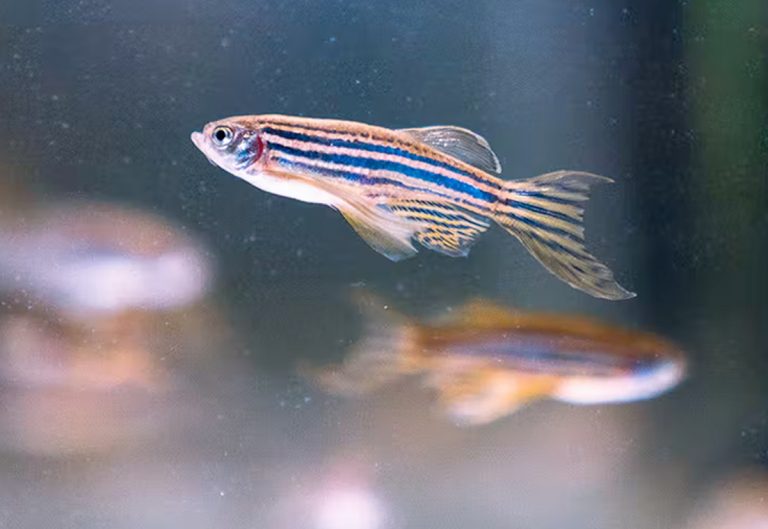
Instead, we used zebrafish. The small, striped tropical fish may seem like an odd choice, until you realise that they are genetically quite similar to humans. For more than 80% of the genes known to cause disease in humans, similar genes are represented in zebrafish.

This fact prompted Stellenbosch University’s Faculty of Medicine and Health Sciences to set up the Zebrafish Research Unit just more than a year ago. Several studies are under way involving advanced analytical pharmacology, toxicology, therapeutic target identification and drug discovery. This study is one of the first to stem from the laboratory.

A variety of data

My research group studies the connection between psychological stress and chronic inflammatory disease. This is especially important in South Africa: the South African Depression and Anxiety group estimates that many as one in six South Africans suffer from anxiety or depression. Furthermore, the current top 10 causes of death in South Africa, like TB, diabetes and respiratory disease, all have inflammation as a common characteristic.

Zebrafish are ideal for drug discovery especially in the context of neurological and inflammatory conditions. We are able to do thorough testing including not only behavioural assessment and seeing how specific treatments work, but also assessing the risks of overdosing and long-term use of potential treatments.

So, we set out to employ our zebrafish models to see whether rooibos might have any positive effects on anxiety. Most of our research is done at the early larval stage, when the zebrafish are not yet considered a sentient animal. It’s a more ethical way of using a live organism in research, as they cannot experience pain at that stage.

We immersed the 2mm-long zebrafish larvae in different concentrations of rooibos in a small dish. Essentially, they were swimming in tea; this is absorbed through their skin as well as through their gills, since their mouths are not yet open.

At different points, specialised equipment tracked their movement and this was used to construct behavioural patterns. Using a model of anxiety – which entails exposing the larvae to alternating bright light and darkness for short periods of time – we assessed whether the larvae swimming in rooibos were able to remain calm, by comparing their behaviour to that of unsupplemented larvae. Normally, in this model, the larvae would “freeze” in bright light, followed by hyperactivity during the periods of darkness. In our study, rooibos-treated larvae also froze, but did not exhibit the anxious hyperactivity.

Oxidative stress

We also performed a test using the live larvae’s behaviour to probe a specific mechanism: a “feel-good” neurotransmitter, GABA, whose signalling can be manipulated by either enhancing or blocking its receptor. If the receptor is blocked, the larvae exhibit a hyperactive seizure-like behaviour. In our study, rooibos was able to completely prevent this response – in fact, it showed similar results to an anti-epileptic drug known to work through GABA.

The behavioural tests were complemented by whole body analyses for oxidative stress and anti-oxidant activity, as well as some cell culture work using human cells. In these models, we showed that green rooibos was able to protect human neurons against oxidative stress.

Oxidative stress increases during life and is actually responsible for ageing, so a product that can protect the brain from oxidative stress, can essentially slow our ageing process. In a world where advances in medicine are allowing us to grow older, it is becoming more and more important to be able to prevent the brain from ageing.

Taken together, our data suggest that green rooibos tea could be considered as a functional brain food. The research suggests it may be a good option as a starting ingredient in the development of new nutraceuticals – pharmaceutical alternatives which claim physiological benefits.

The results of this study mean that we could have uncovered nature’s contribution to treating some of South Africa’s health problems. It shows that drinking green rooibos tea may have a calming effect if you suffer from anxiety.

Zebrafish in research

This certainly won’t be the last piece of research from our lab or others that use zebrafish in drug discovery. The fish, which originate in Malaysia, may be the new rodent in research. Apart from their genetic similarities to humans, when in their larval stage the fish are fairly transparent; that makes them great for microscopy.

We have a couple of tanks where we breed with the adult stock. The fish can live up to three years in a laboratory, compared to about a year in nature (because of excellent care in the lab, but also the absence of natural predators).

In terms of future research, assessing these effects in humans is on the cards. We are also generating very promising results on rooibos in the context of inflammatory bowel syndrome, a chronic condition affecting approximately 10% of the global population and which is the most common co-morbidity to anxiety disorders.

Carine Smith, Professor in Pharmacology, Division for Clinical Pharmacology, Stellenbosch University

This article is republished from The Conversation under a Creative Commons license. Read the original article.

South Africa undertakes its most important census since the end of apartheid

0

David Everatt, University of the Witwatersrand

Statistics South Africa has embarked on its once-a-decade process to count all people in the country – including non-citizens. Census 2022 is arguably the most important in the country since the first post-apartheid census in 1996.

That census was the first time since the end of apartheid in 1994 that all South Africans were counted. Under apartheid, fictitious “homelands” excluded millions of people from the count. Excluding them allowed the apartheid government to deny their rights, and responsibility for meeting their needs – by not counting them, the apartheid government ensured that they did not count, for anything.

Homelands or Bantustans were ten mainly rural, underdeveloped areas where black South Africans were required to live and have nominal “self-rule” and “independence”, along ethnic group lines, separate from whites. They had their own censuses.

The 1996 census was a vital tool to inform every government department, economic entity, and every citizen, about the state of the nation, the depth of need, and the location of needs to be met. While it is a legal obligation for everyone to complete a census form, the 1996 census saw a real willingness to participate and to get counted – from a newly liberated population, still basking in the post-apartheid moment.

Fast-forward past the last census of 2011 to the present. In the period since then, the country has witnessed state capture, a former president (briefly) in prison, a collapse in the provision of basic services such as water, rising violence and hostility to “foreigners”.

The country also has appalling rates of gender-based violence, and is reeling from a global pandemic coming on top of the disease burden already afflicting South Africans. COVID-19 took many lives and wrecked many more livelihoods. After two years of pandemic, lockdowns and curfews, accompanied by and amplifying cynicism about the institutions of government and political parties, South Africa is in a bad space.

The recent local elections saw the lowest ever turnout, with only the Northern Cape province seeing over half its voters actually cast a ballot. Stories of massive corruption in procuring personal protective equipment and unnecessary “deep cleaning” of public buildings cemented the view of both politicians and public servants as self-interested to the point of lacking all empathy for citizens.

With frequent power cuts further sapping the will, South Africans have reached a remarkably low point when it comes to faith in government or politics.

Census and accountability

In this context, Statistics South Africa (Stats SA) launched Census 2022, and has asked all people in the country to “get counted”. Cynicism about politicians and public officials should not blind South Africans to the power of data, and the pooled facts of all the lives being lived in South Africa right now, and the story they will tell of the past decade.

The census is a tool for accountability: it is the ultimate judgement on how all governments have performed, from cities to provinces to national, and thus also on all parties involved in governance. The census will be a reckoning for what has gone before, as well as critical for all planning in society going forward.

The census will inform economics, social policy, health care and investment. It is a tool to understand what has happened to South Africans in the last 11 years since Census 2011, and a critical planning tool as we look to the future.

This is not the time to withhold participation, as people did in the recent elections: this is time to make sure we get counted, so that all are given a deeply accurate portrait of life in South Africa today. The picture may or may not be pretty: but it will be powerful, and inescapable.

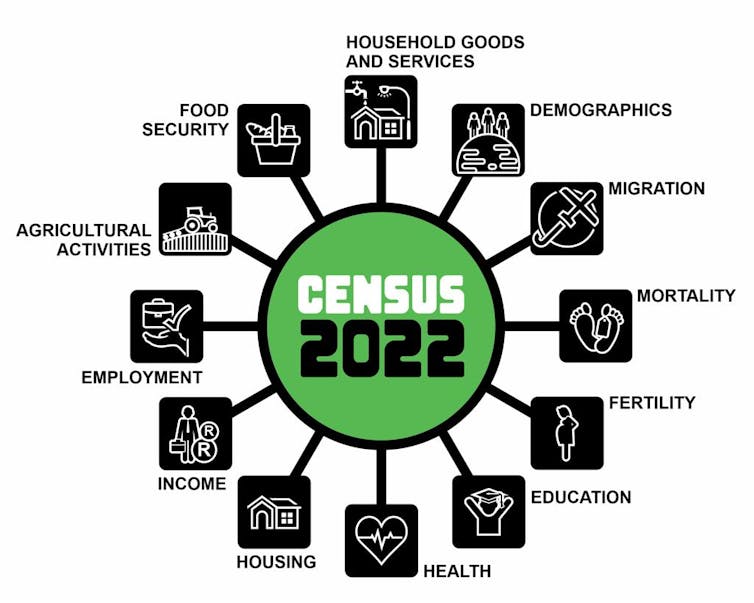
Data to be collected across multiple domains during Census 2022. Stats SA

Despite the challenges of the last few years – which included repeated funding cuts as well as the impact of the pandemic – Stats SA has moved relentlessly to prepare for the census.

To deal with both a reluctance to participate and the effect of COVID-19, everyone can choose how to complete the census – online, on a phone, or in person. Stats SA has done what it can to make it comfortable for everyone to participate.

Every count matters

The cynicism about government and politics is warranted – as the reports of the Zondo Commission into state capture are making clear.

But Stats SA is not a government department – it forms part of the state machinery, just as the Chapter 9 institutions, which protect the country’s democracy, do. State capture did not extend to Stats SA, which is an autonomous entity, led by an entirely independent Statistician-General, advised by an independent Statistics Council.

It is staunchly independent of outside influence, be it from government, political parties or others. Census 2022 will be the most defining judgement of how government has managed South Africa since 2011. Stats SA is the custodian of the data, protected by law – not government.

The census will count everyone in South Africa. This includes citizens, visitors and migrants, people living without shelter, in institutions, and so on. Counting undocumented migrants will provide a better idea of how many “foreigners” are actually in South Africa, rather than relying on speculation and political rhetoric.

The census will focus everyone on the core challenges the country faces, where they are, and who is most affected.

By law, the raw data cannot be shared with other government departments (or anyone else), as directed by the National Statistics Act. Stats SA protects the data, processes and analyses it, and shares results in a way that no individual can possibly be identified or located.

All people should “get counted” so that their voices are heard, their needs identified, and South Africa can plan for a better future.

David Everatt, Professor of Urban Governance, University of the Witwatersrand

This article is republished from The Conversation under a Creative Commons license. Read the original article.
The Real Story behind Mrs H.S. Ball’s Chutney

0

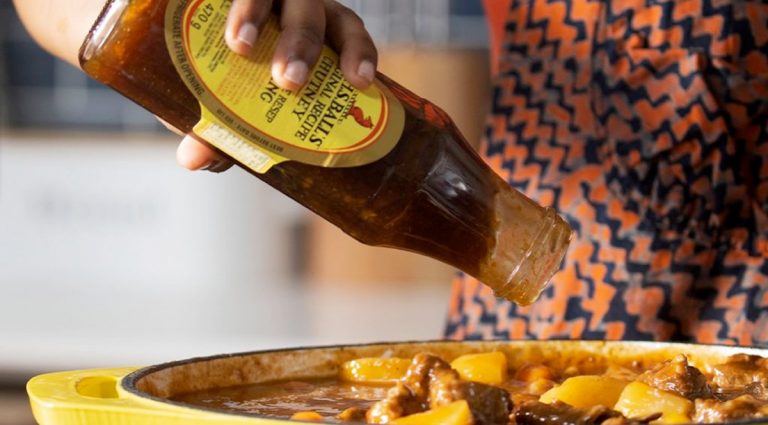
Mrs. Balls Chutney is an original South African favourite, with perfect all-round use and found in almost every South African household.

Rumour has it Mrs H.S. Ball’s Chutney originated in Canada and was brought to South Africa aboard the SS Quanza that was shipwrecked off the coast of East London, South Africa. As interesting as this may sound it is a little far from the truth.

In 1852, Mr Henry James Adkins, a retailer in East London (who incidentally bought the shipwreck for recycling) married Elizabeth Sarah Spalding, they settled in Fort Jackson and ran a general store.

In 1870 Sarah Adkins started making chutney which quickly became a popular condiment amongst the locals. It was initially named, “Mrs Henry Adkins Senior, Colonial Chutney Manufacturer, Fort Jackson, Cape Colony.”

Although Sarah Adkins had the skills to create a delicious chutney she did not have the skills to market her brand. It was actually her daughter, Amelia who took the brand to the next level.

In 1886 Amelia Adkins married Herbert Ball in East London. They moved to Johannesburg, taking her mother’s famous chutney recipe with her. By 1914, Amelia had perfected the recipe and it had become a popular bottled condiment at church bazaars and markets, Mrs H.S. Ball’s Chutney.

In 1921 the Ball family had moved to Cape Town, Fish Hoek where Amelia continued to make and bottle her chutney. Her husband would take a few bottles a day to sell in Cape Town, it is here he met Fred Metter, a food exporter who took on the marketing and sales of the brand.

In a short time, they outgrew their premises in Fish Hoek and moved to larger factories in Deep River and later in Retreat.

In 1957, the chutney was exported to the UK for the first time. Over the years the business was sold to Brooke Bonds OXO then later to Unilver. Now owned by Tiger Brands it is a global brand distributed all over Africa, the UK, Germany, Australia and New Zealand.

Although there are 5 different flavours, Mrs H.S. Ball’s Original remains the favourite.

At £2.25 a bottle, it gets a 4.5-star rating from Tesco shoppers, you’ll find it at Sainsbury’s too.

Picture: Facebook / Mrs Ball’s Chutney

Find out more at: https://bit.ly/3xJlZ49

Follow South Africans UK on Facebook and Instagram.

Join the South African UK map and subscribe to our newsletter.

Kevin Fraser – I’MPOSSIBLE

0

Popular South African comedian living in Australia, Kevin Fraser will be performing live in the UK this spring with his I’MPOSSIBLE 2022 tour in London, Manchester, Brighton, Dublin and Glasgow.

London tickets Phase 1 are sold out but check in on Tuesday, 8th Feb at 9am GMT when Phase 2 of London tickets will be on sale.

Visit kevinfraserofficial.com for more information and for ticket sales.

What you need to know to apply for Indefinite Leave to Remain in the UK

0


Are you a South African expat planning to settle in the UK? You may need to apply for Indefinite Leave to Remain (ILR).


Data published by the UK’s office for national statistics in March 2021, shows that a significant number of South Africans have made a move to the UK permanently, despite travel being significantly impacted by the Covid-19 pandemic.

ILR, or UK settlement, grants an applicant the right to live and work in the UK without any immigration restrictions and is the first step towards naturalization as a British citizen. Typically, you must have spent at least five years in the UK before you can apply for ILR, though in certain circumstances you can apply after three or two years.


There are different ways to apply for ILR:
If you work in the UK
If you have family in the UK
If you’ve lived in the UK for 10 years
If you’re a Commonwealth citizen


To make an application for ILR you will need to complete the relevant form and compile the supporting documents to submit to the Home Office. You will also need to prove your English skills through a Secure English Language Test or SELT.


If you’re looking for a fast, convenient and low-preparation Secure English Language Test, consider taking PTE Home.

Approved by the UK Home Office, PTE Home has levels of test A1, A2 and B1. It is a speaking and listening test that gives a pass or fail result, typically within 48 hours. PTE Home is taken on a computer in a secure and friendly test environment. And what’s better, you won’t need to prepare a topic in advance unlike with other SELT providers.


What’s even better, readers of South Africans in the UK can now benefit from a 10% discount simply by using the voucher code SAUK10 at checkout. Book your test here.


5 Tips to Succeed in your English Test for a UK Visa or IRL

0

Are you a South African expat applying for a UK visa or Indefinite Leave to Remain (IRL)? You will need to prove your English skills through a Secure English Language Test or SELT. Here’s some practical advice to help you ace your exam.

To do well, you won’t need to write essays, or read complicated articles. You also won’t need to talk about things which you never normally speak about. You will mainly need to talk about the things that are important to you. The following tips will help you do this: 

• Describe images you see in magazines or newspapers. Explain what you can see and guess what the article is about.
• Talk about the things that are happening around you when you’re with friends or family.
• Talk about how things in the UK are different from South Africa. How are they different? What do you think of them?
• Describe your day to your friends or family members.
• Tell your friends or family simple stories in English. It could be funny or interesting things that people have said or done.

If you’re looking for a fast, convenient and low-preparation Secure English Language Test, consider taking PTE Home. Approved by the UK Home Office, PTE Home has levels of test A1, A2 and B1. It is a speaking and listening test that gives a pass or fail result, typically within 48 hours. PTE Home is taken on a computer in a secure and friendly test environment. And what’s better, you won’t need to prepare a topic in advance unlike with other SELT providers.


What’s even better, readers of South Africans in the UK can now benefit from a 10% discount simply by using the voucher code SAUK10 at checkout. Book your test here.

Social media channels:
Twitter
Facebook
Instagram
• YouTube

Find out more at: https://bit.ly/3xJlZ49

Follow South Africans UK on Facebook and Instagram.

Join the South African UK map and subscribe to our newsletter.

Rassie is trending on Twitter

0

South African director of rugby Rassie Erasmus was given a 2-month ban on all rugby activities back in November 2021.

In the meantime, Rassie has taken to Twitter with a series of entertaining videos that South Africans are loving.

A touch of Ban Ban Baby ft Ice Ice Baby.

Day 29 of 60 and Rassie is handling every day as a Friday!

Also featuring Frankie, the Irish Bulldog.

Follow Rassie on Twitter for more.

Tips to beat SAD this Winter

0

South Africans living in the UK often battle in the winter months with the shorter days and lack of sunshine. We are used to soaking up the sun at this time of the year back home.

Many are prone to feeling down at this time of the year and may suffer from SAD, Seasonal affective disorder. A type of depression that often arises in the winter. SAD can cause a low mood, loss of pleasure and interest in daily activities, lack of energy and generally not wanting to get out of bed.

The exact cause of SAD is not completely understood but it is linked to reduced exposure to sunlight during the winter months.

Here are a few ideas to try to help lift your mood

  • Get as much natural sunlight as possible
  • Get regular exercise, a short walk everyday will do the world of good. Aim for 30 minutes a day
  • Put on your favourite music and dance
  • Open blinds, curtains to increase the amount of natural light in your home
  • Get a lightbox or lamp that simulates natural sunlight to brighten up your mood
  • Darkly painted walls can add to the dullness, repaint a lighter shade
  • Make the effort to get out and meet friends for a catchup
  • Join a club, take a course and meet new people
  • Watch funny movies or video clips to make you laugh
  • Involve the family in a games evening
  • Eat correctly with well balanced meals and lots of fresh fruit and vegetables
  • Do something you enjoy everyday, whether it’s painting or working on the car
  • If work is overloaded and you are under pressure take measures to minimize your stress
  • Talk about how you are feeling with friends and family

If you’re struggling to cope please consult your GP who can carry out an assessment.

Find out more at: https://bit.ly/3xJlZ49

Follow South Africans UK on Facebook and Instagram.

Join the South African UK map and subscribe to our newsletter.

SA artists Black Coffee and Wouter Kellerman Nominated for a Grammy

0

South African world famous DJ, Black Coffee has been nominated for a Grammy Award in the Best Dance/Electronic Album category for his latest album Subconsciously.

Black Coffee goes up against other international DJs including Sylvan Esso and Major Lazer.

In the Best New Age Album category, South African award-winning flutist Wouter Kellerman has been nominated for a another Grammy Award for the Pangaea album with David Arkenstone.

Kellerman received a Grammy Award at the 57th Annual Grammy Awards for his 2014 album Winds of Samsara.

Find out more at: https://bit.ly/3xJlZ49

Follow South Africans UK on Facebook and Instagram.

Join the South African UK map and subscribe to our newsletter.

Justin Bieber live in South Africa in 2022

0

Johannesburg and Cape Town are on the list for Justin Biebers World tour in 2022.

From May 2022 through to March 2023, Justin Bieber will tour five continents, travelling to over 20 countries and playing more than 90 dates.

On 28th September 2022, he performs at the DHL Stadium in Cape Town before heading to Johannesburg for another show on 1 October 2022 at the FNB Stadium.

The Justice World Tour is Bieber’s first global performance since the Purpose World Tour in 2016/2017. 

Pre-sale tickets start on Wednesday 1 December from www.ticketmaster.co.za

General ticket sales from Friday 3 December.

Find out more at: https://bit.ly/3xJlZ49

Follow South Africans UK on Facebook and Instagram.

Join the South African UK map and subscribe to our newsletter.